

In global trade, aluminum coil price per pound is the mainstream settlement method in the European, American, and Southeast Asian markets, which better aligns with the purchasing and accounting habits of overseas customers compared to traditional ton prices. The aluminum coil price per pound is not fixed and constantly adjusts dynamically based on international market conditions, raw material costs, and market supply and demand.
The core pricing anchor for international aluminum coil prices is the LME London aluminum ingot spot price. As of late May 2026, the LME aluminum spot cash price was $3665/ton. Using the internationally accepted conversion formula (1 ton = 2204.62 pounds), the benchmark price for pure aluminum raw materials is approximately $1.66/pound. Combined with Kitco commodity real-time data, the current spot aluminum price range is stable between $1.67 and $1.68, with minimal price differences between futures and futures markets, indicating a high degree of uniformity in global raw material benchmark prices.
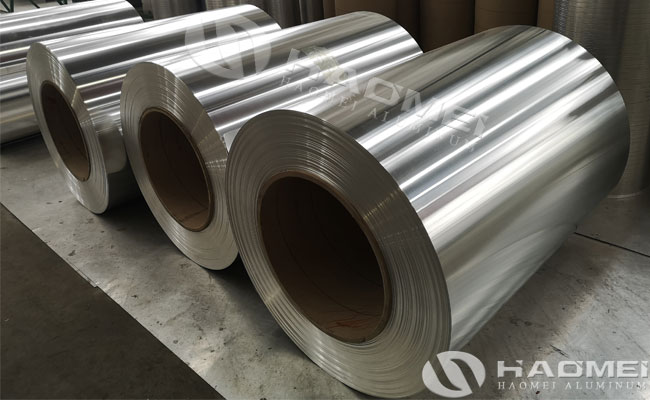
Aluminum coils are a type of deep-processed aluminum product. The actual foreign trade transaction price must be based on the benchmark price of pure aluminum raw materials, plus various processing and technological premiums. Currently, mainstream FOB quotations at Chinese ports are clear and well-defined: 1000 series pure aluminum coils are priced at $1.85–2.10/lb, suitable for general insulation, packaging, and general sheet metal applications; 3003 rust-proof aluminum coils and 5052 corrosion-resistant alloy aluminum coils, commonly used in industry, are priced stably between $2.00–2.35/lb, suitable for high-end applications in chemical, equipment, and transportation sectors.
Aluminum coil prices consist of three parts: aluminum ingot cost, processing value-added, and market premium. The weight of each component adjusts dynamically according to product type.
- Aluminum ingot benchmark cost:
Accounting for 70%-85%, it is the core driver of price fluctuations. In May 2026, aluminum prices rose 18.45% from the beginning of the year, mainly due to production cuts by large smelters such as EGA caused by geopolitical conflicts in the Middle East, LME inventories falling to their lowest level since 2008, and spot premiums reaching $77/ton, exhibiting a clear spot premium structure.
- Value-added processing costs:
Accounting for 15%-30%, covering processes such as hot rolling, cold rolling, annealing, and slitting. Taking a 0.68mm thick 1060 aluminum coil as an example, the processing fee is approximately US$0.20-0.30 per pound. High-precision rolling (tolerance ±0.01mm) and mirror finishing can increase the processing fee by 40%-60%.
- Market premium factors:
Including alloy composition (3003 with manganese adds US$0.12-0.18 per pound, 5052 with magnesium adds US$0.15-0.22 per pound), surface treatment (color coating adds US$0.30-0.50 per pound, anodizing adds US$0.25-0.40 per pound), and customized specifications (narrow width <500mm or wide width >1800mm adds US$0.10-0.20 per pound).
Macroeconomic conditions and regional differences directly influence short-term fluctuations in aluminum coil prices. Currently, the continued volatility of the US dollar index is putting downward pressure on commodity prices, while domestic electrolytic aluminum capacity limits are maintaining a price floor for the industry, keeping overall aluminum coil prices volatile at high levels. Regional price differences are also significant. Influenced by tariffs, shipping costs, and regional supply and demand policies, the CIF price of aluminum coil in the North American market is $0.35–0.50/lb higher than the FOB price in China; the Southeast Asian market has more flexible trade policies, resulting in relatively larger price fluctuations.
Based on 20 years of export experience, we recommend that buyers optimize their cost structure by considering price cycles, product characteristics, and cooperation models.
- Price Cycle Management:
Currently, we are in a spot premium phase. We recommend that small and medium-sized buyers adopt a "small batch, frequent shipments" strategy. If signing long-term contracts, embedding LME price ±5% floating clauses can mitigate the risk of unilateral price increases.
- Product Selection Optimization:
For non-structural applications, 1060/1100 pure aluminum coils are preferred, with costs $0.15-0.20/lb lower than the 3003 aluminum coil. For applications requiring high corrosion resistance, the 5052 series offers better value than the 7000 series, with a price difference of $0.40-0.60/lb.
- Innovative Cooperation Model:
Direct quarterly framework agreements with factories such as Haomei Aluminum allow for a 5%-8% reduction in processing fees. For the North American market, assembly in Mexico and re-export are possible, avoiding some tariff costs.
The price of aluminum coils is projected to reach $1.90-2.00/lb in Q3 2026, and may rebound to $1.70-1.80/lb in Q4 as Indonesian production capacity increases. In practical terms, we recommend that buyers: Lock in the average price of LME three-month futures as the pricing benchmark; Request suppliers to provide itemized quotations for "aluminum ingot price + processing fee"; Establish 2-4 weeks of safety stock to avoid the risks of price fluctuations and supply chain disruptions.
For overseas buyers, abandoning a purely price-comparison mindset and focusing on pricing transparency and quality stability are the core keys to long-term cost control.
About Us
| News
| Products
| Download
| Contact Us
Haomei Aluminum is a large-scale listed company in China, which is engaged in the processing of aluminum sheet, aluminum coil, aluminum strip, aluminum circle and aluminum foil. With an annual capacity of 200,000 tons, Haomei Aluminum provides varieties of aluminum products to more than 30 countries in the world.
Address: No.14 Waihuan Road, New district, Zhengzhou, China.


