

Both 5052 and 5083 aluminum belong to the aluminum-magnesium series of rust-resistant alloys. Their distinct magnesium content leads to significant differences in performance, positioning them for different applications: general corrosion-resistant use versus marine-grade (high-corrosion resistance) use. In practice, these two aluminum alloys are sometimes confused; selecting the wrong one can directly impact the service life of a component and its overall cost. Based on the ASTM B209 standard and our extensive manufacturing and supply experience, we can provide a precise comparison of 5052 and 5083 aluminum across three dimensions: composition, properties and application scenarios.
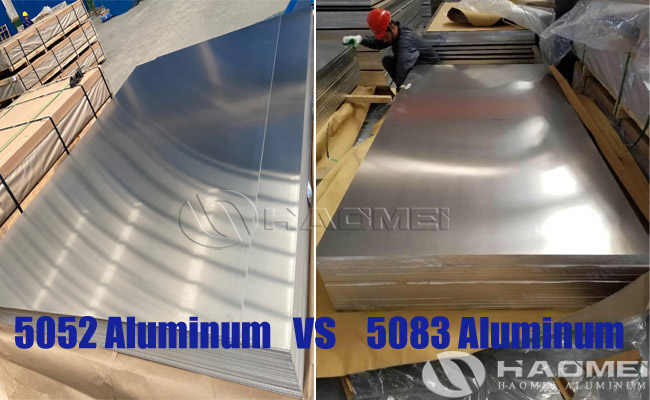
Differences in chemical composition are the fundamental reason for the variation in performance. The 5052 aluminum alloy contains 2.2%–2.8% magnesium, 0.1%–0.35% manganese, and 0.15%–0.35% chromium—a combination that provides a balance between basic corrosion resistance and strength. In contrast, the 5083 aluminum alloy features a higher magnesium content of 4.0%–4.9% (nearly double that of 5052), with manganese increased to 0.4%–1.0% and chromium adjusted to 0.05%–0.25%. Through enhanced solid-solution strengthening (via magnesium) and grain refinement (via manganese), the 5083 alloy achieves a significant improvement in both strength and resistance to stress corrosion. Due to its higher alloy content, the material cost for 5083 is 10%–20% higher than that of 5052 for the same specifications.
Quantifiable differences in mechanical properties directly determine the load-bearing capacity of a structure. Taking the most commonly used stabilized temper (H32) as an example: 5052-H32 aluminum sheet has a tensile strength range of 210–260 MPa, a specified 0.2% offset yield strength (non-proportional extension strength) of ≥190 MPa, an elongation at break of ≥12%, and a Brinell hardness of approximately 60–75 HB. In comparison, 5083-H32 aluminum sheet has a tensile strength range of 290–350 MPa, a specified 0.2% offset yield strength of ≥225 MPa, an elongation at break of ≥12%, and a Brinell hardness of approximately 85–100 HB—offering an overall strength that is about 35% higher. For marine applications, the 5083-H116 aluminum provides a stable tensile strength of 305–345 MPa and a yield strength of ≥215 MPa; it is specifically optimized for resistance to stress corrosion cracking while maintaining structural integrity.
Differences in corrosion resistance and processability dictate their respective suitability for various fabrication and service environments. Regarding salt-spray resistance, 5052 aluminum shows no significant corrosion after 500 hours of neutral salt-spray testing, with an annual corrosion rate of less than 0.01 mm in industrial atmospheric environments. 5083 aluminum exhibits only slight surface corrosion after 1,000 hours of neutral salt-spray testing; in seawater immersion, its annual corrosion rate is approximately 33% lower than that of 5052 aluminum, demonstrating a clear advantage in resistance to pitting and stress corrosion. In terms of formability, 5052 aluminum allows for a minimum bending radius of approximately one times the sheet thickness and can withstand multiple consecutive bends without cracking, making it superior for complex forming. Conversely, 5083 aluminum requires a minimum bending radius of two to three times the sheet thickness, making it better suited for structural applications that involve minimal bending but extensive welding. Both alloys exhibit excellent weldability; 5083 aluminum retains over 90% of its strength in welded joints, making it well-suited for the modular welding processes used in large-scale marine structures.
The core principle for selecting the appropriate material lies in balancing specific operating conditions with cost considerations. 5052 aluminum alloy is designed for general anti-corrosion applications. Offering a cost-effective solution with excellent formability, it is well-suited for equipment enclosures, ventilation ducts, building envelopes (in inland regions), automotive sheet metal, and atmospheric storage tanks—striking an ideal balance between rust resistance and processing efficiency. 5083 aluminum alloy, by contrast, is a high-strength, corrosion-resistant, marine-grade material. It is engineered for use in ship hull plating, offshore platform structures, shipping containers, cryogenic LNG storage tanks, and structural components in coastal areas exposed to high levels of salt spray. Based on extensive export experience, opting for aluminum 5052 in standard inland environments can reduce material costs by 10%–15%, while utilizing aluminum 5083 in highly corrosive coastal environments can more than double the service life of components, thereby lowering long-term maintenance and replacement expenses.
Both 5052 and 5083 aluminum plates from Haomei Aluminum are manufactured in strict accordance with international standards. They are available in a full range of tempers and thicknesses, with support for certifications from classification societies such as ABS and DNV. We also provide value-added services, including precision cutting to size and comprehensive export support. Our team offers expert guidance on material selection tailored to specific operating conditions, helping clients achieve the optimal balance between performance requirements and procurement costs.
About Us
| News
| Products
| Download
| Contact Us
Haomei Aluminum is a large-scale listed company in China, which is engaged in the processing of aluminum sheet, aluminum coil, aluminum strip, aluminum circle and aluminum foil. With an annual capacity of 200,000 tons, Haomei Aluminum provides varieties of aluminum products to more than 30 countries in the world.
Address: No.14 Waihuan Road, New district, Zhengzhou, China.


