

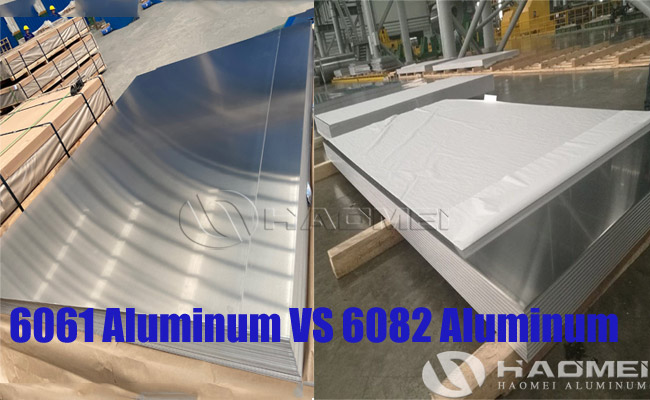
Both 6061 and 6082 aluminium belong to the aluminum-magnesium-silicon (Al-Mg-Si) alloy family and are heat-treatable. They serve as primary structural aluminum materials under American (ASTM) and European (EN) standards, respectively. While their properties are similar, their compositional designs differ, catering to distinct applications: 6061aluminum is a versatile, balanced-performance alloy, whereas 6082 aluminum is engineered for heavy-duty structural use. In procurement, they are often treated as equivalent substitutes; however, overlooking subtle differences can lead to lower manufacturing yields or insufficient structural safety margins. Based on ASTM and EN standards, as well as extensive production and supply experience, this guide provides a systematic comparison across three dimensions: chemical composition, mechanical properties, and application scenarios.
Chemical Composition:
6061 aluminum alloy contains 0.4%–0.8% silicon and 0.8%–1.2% magnesium, with 0.15%–0.4% copper added for reinforcement and manganese kept at ≤0.15%. This balanced composition offers an optimal combination of strength, ductility, and suitability for surface treatments.
In contrast, 6082 aluminum alloy features a higher silicon content (0.7%–1.3%) and a significantly higher manganese content (0.4%–1.0%), while copper is limited to under 0.1%. The increased silicon-magnesium precipitates and the grain-refining effect of manganese significantly boost the alloy's strength. Furthermore, iron impurities are strictly controlled (≤0.5%) to enhance the material's toughness.
A higher degree of alloying results in raw material costs for aluminium 6082 that are 8%–12% higher than those for aluminium 6061 of the same specifications, establishing a clear product positioning hierarchy.
Mechanical Properties:
For standard aluminum plates with a thickness of 3 mm to 20 mm, aluminum 6061-T6 exhibits a tensile strength of 290–320 MPa, a yield strength (proof stress) of ≥240 MPa, an elongation at break of ≥10%, and a Brinell hardness of approximately 95 HB.
In comparison, aluminium 6082-T6 offers a tensile strength of 295–330 MPa, a yield strength of ≥250 MPa, an elongation at break of ≥8%, and a Brinell hardness of approximately 95–100 HB.
Overall, 6082 aluminium provides a yield strength that is about 4% higher, offering a greater safety margin for structural load-bearing, while 6061aluminum boasts superior elongation, making it better suited for cold-forming processes. Both alloys have an elastic modulus of approximately 69 GPa and a density of 2.70 g/cm³, meaning they offer identical benefits for lightweight structural design.
Performance and Machining Suitability:
Regarding machinability, aluminum 6061 offers more stable cutting performance with a lower tendency for material to adhere to the cutting tool; it can achieve a surface roughness of Ra 1.6 μm during precision machining, making it ideal for high-precision molds and tooling. Aluminium 6082, being slightly harder, causes faster tool wear and is better suited for structural cutting applications that require fewer processing steps.
In terms of surface treatment, 6061 aluminum produces a uniform, fine anodic oxide layer with excellent color consistency, making it superior for decorative purposes. Due to its higher manganese content, 6082 aluminium results in a slightly darker tone after anodizing, making it more suitable for functional applications.
Both alloys exhibit similar welding performance, with joint strength retention exceeding 75% when welded using 5356 filler wire.
In terms of corrosion resistance, both alloys exhibit excellent resistance to atmospheric corrosion. 6082 aluminium, however, offers slightly superior resistance to stress corrosion cracking—a benefit of the grain-refining effect of its manganese content—making it well-suited for most outdoor industrial environments.
Application Scenarios:
6061 aluminum is positioned as a versatile, general-purpose structural aluminum alloy; it is widely used for precision tooling and molds, frames for automated equipment, electronic structural components, lightweight automotive parts, and architectural decoration. It enjoys the highest level of acceptance in markets that follow North American standards, such as those in North America and the Middle East.
Aluminium 6082 is positioned as a high-load structural aluminum alloy and is a standard grade under the European "Eurocode 9" structural code. It is frequently employed in applications requiring high safety margins, including bridge trusses, lifting equipment, commercial vehicle chassis, rail transit structures, and load-bearing components for marine vessels.
Based on years of export experience, over 60% of engineering drawings based on European standards explicitly specify aluminium 6082, while projects based on North American standards predominantly favor aluminum 6061. Any substitution between these two across different standard systems requires prior performance verification.
Haomei Aluminum’s 6061 and 6082 aluminum plates are manufactured in strict accordance with their respective international standards. They are available in T6 and T651 tempers, with thickness specifications ranging from 0.5 mm to 150 mm. We support third-party testing and classification society certifications. Furthermore, we provide precise selection guidance tailored to a client’s specific market region and operational requirements, helping them strike an optimal balance between structural performance and procurement costs.
About Us
| News
| Products
| Download
| Contact Us
Haomei Aluminum is a large-scale listed company in China, which is engaged in the processing of aluminum sheet, aluminum coil, aluminum strip, aluminum circle and aluminum foil. With an annual capacity of 200,000 tons, Haomei Aluminum provides varieties of aluminum products to more than 30 countries in the world.
Address: No.14 Waihuan Road, New district, Zhengzhou, China.


