

5052 and 6061 are the two most frequently inquired-about medium-strength, general-purpose aluminum alloy grades in industrial procurement. Both are among the most widely used wrought aluminum alloys in global industry, yet they have differences regarding composition, performance characteristics, and suitable applications. When faced with price quotes for these two grades, some engineers and procurement professionals make selection errors due to an incomplete understanding of their performance differences; this can lead to either "over-specification" (driving up costs) or "under-specification" (resulting in costly batch rework later). The following analysis breaks down the core differences between the 5052 and 6061 aluminum from a technical perspective to guide material selection.
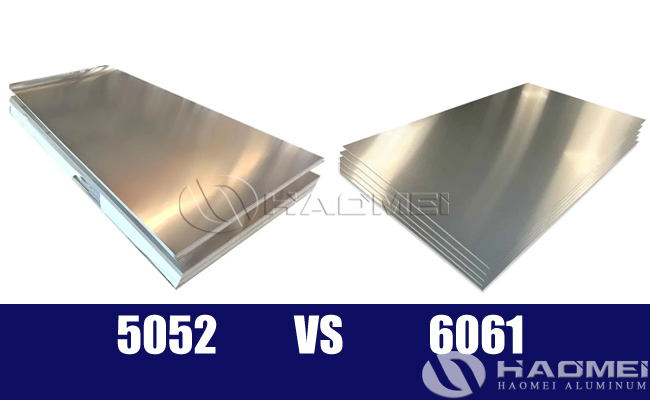
In terms of alloy systems, 5052 is an Al-Mg (aluminum-magnesium) alloy characterized by corrosion resistance and non-heat-treatability. Its magnesium content is strictly controlled between 2.2% and 2.8%; it derives its base strength from the solid-solution effect of magnesium atoms, meaning its overall performance cannot be significantly enhanced through heat treatment. In contrast, 6061 is a heat-treatable Al-Mg-Si (aluminum-magnesium-silicon) alloy, containing 0.45%–0.9% magnesium and 0.4%–0.8% silicon. It achieves a substantial increase in strength through the precipitation of a second phase during solution treatment and artificial aging, offering a wide performance range—from the soft state to peak-aged conditions—and greater flexibility in strength adjustment.
Comparing key mechanical parameters in their most common delivery states: for 5052 H32 (stabilized) temper is the most widely used in industry, offering a tensile strength of 210–260 MPa, a yield strength (0.2% offset) of ≥150 MPa, an elongation at break of ≥12%, and a Brinell hardness of approximately 60–75 HB. For 6061, the T6 (peak-aged) temper is the most common, providing a tensile strength of 265–320 MPa, a yield strength (0.2% offset) of ≥245 MPa, an elongation at break of ≥8%, and a Brinell hardness of approximately 90–120 HB. For the same thickness, 6061-T6 aluminum sheet offers approximately 35% higher structural load-bearing capacity than 5052-H32, demonstrating superior long-term stability regarding dent and deformation resistance.
The two alloys offer distinct advantages regarding processing suitability. Aluminum 5052 offers outstanding resistance to marine salt spray corrosion—withstanding over 720 hours in neutral salt spray tests—and retains over 90% of its welded joint strength. It also features excellent bending formability; for a 1.0mm thick 5052 aluminum sheet, the minimum radius for a 90° cold bend is approximately 1.5 times the sheet thickness. In contrast, aluminum 6061 offers superior machining stability, with no issues regarding tool adhesion or built-up edge formation during cutting, and allows for easy control of surface roughness during finishing. Its anodized coating is uniform and dense, yielding excellent coloring results. In the T651 stress-relieved state, post-machining flatness deformation is ≤0.05mm/m, making it ideal for high-precision tooling and mold applications.
Material selection can be quickly determined based on core requirements: choose 5052 aluminum alloy for coastal outdoor equipment, marine sheet metal, welded liquid storage tanks, or corrosion-resistant enclosures; choose 6061 aluminum alloy for equipment frames, tooling fixtures, mold bases, or structural supports for new energy applications. Years of export experience have revealed common selection errors: using aluminum 6061 for coastal outdoor sheet metal parts often leads to surface pitting within two years due to insufficient corrosion resistance; conversely, using aluminum 5052 for precision machined structural parts results in high rework rates due to significant post-machining deformation, ultimately driving total procurement costs up by more than 20%.
As a professional manufacturer and supplier of aluminum sheets, we produce our 5052 and 6061 series in strict accordance with ASTM B209 standards, covering a full range of alloys, tempers, and thicknesses. Each batch comes with a comprehensive material test report, and we provide precise selection recommendations based on specific processing methods and operating conditions to help customers achieve the optimal balance between performance and cost.
About Us
| News
| Products
| Download
| Contact Us
Haomei Aluminum is a large-scale listed company in China, which is engaged in the processing of aluminum sheet, aluminum coil, aluminum strip, aluminum circle and aluminum foil. With an annual capacity of 200,000 tons, Haomei Aluminum provides varieties of aluminum products to more than 30 countries in the world.
Address: No.14 Waihuan Road, New district, Zhengzhou, China.


