

The EN AW 5754 H111 aluminum plate supplied by Haomei Aluminum is a medium-strength, rust-resistant Al-Mg alloy plate produced in strict accordance with EU EN standards; it is a product specifically optimized for welding applications in the European industrial market. Through precise process control—combining full annealing with slight cold-work hardening—the H111 temper retains moderate structural strength while maintaining extremely low residual stress levels. It is perfectly suited for industrial applications involving welding and light bending, making it a preferred base material for welded structural components in sectors such as automotive manufacturing, shipbuilding, and construction.
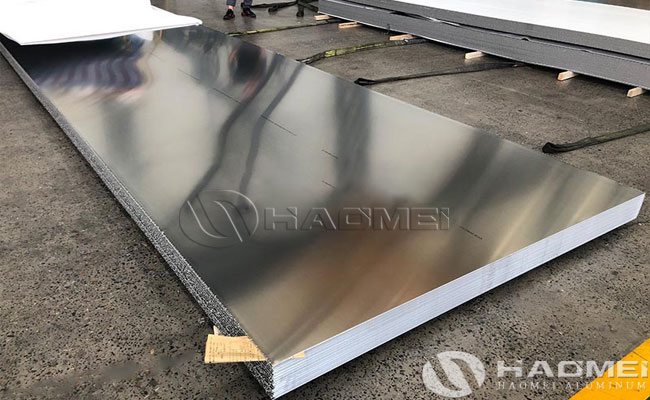
Regarding material composition and process control, the 5754 h111 aluminum plate strictly complies with the EN 573-1 standard, with magnesium content controlled between 2.6% and 3.6%. Grain refinement is achieved through the addition of 0.1%–0.6% manganese and 0.05%–0.2% chromium, endowing the material with the excellent atmospheric and salt-spray corrosion resistance characteristic of Al-Mg alloys, while eliminating the risk of intergranular corrosion. During production, the material undergoes full annealing in a controlled atmosphere at 360°C–400°C to ensure complete grain recrystallization, followed by light cold rolling (with a deformation rate of no more than 8%) to achieve the H111 temper's slight hardening. This process avoids the low strength associated with a fully annealed state while keeping internal residual stress at a minimal level. For commonly used thicknesses of 1.0 mm to 3.0 mm, the 5754 aluminum plate product demonstrates stable tensile strength (210–260 MPa), a proof strength (0.2% offset) of ≥120 MPa, and an elongation at break of ≥18%. Hardness deviation across the entire sheet width is within ±4 HB, ensuring excellent performance uniformity. Dimensional accuracy complies with the EN 485-4 standard; thickness tolerance is controlled within ±0.05 mm, and surface flatness is ≤0.3 mm/m, allowing for direct integration into automated welding and stamping production lines.
Excellent weldability and corrosion resistance stability are the core competitive advantages of EN AW 5754 H111 aluminum plate. This material grade exhibits low residual stress, ensuring uniform thermal stress release during welding and significantly lower susceptibility to weld cracking compared to high-work-hardening tempers. It supports various automated welding processes—such as MIG, TIG, and laser welding—achieving weld joint strength retention of over 85%. Furthermore, the corrosion resistance of the weld zone is virtually identical to that of the base material, eliminating the risk of stress corrosion cracking. We have worked with numerous European commercial vehicle manufacturers who previously used 5754 H24 (half-hard) aluminum plate for welding fuel tanks and chassis skid plates; they experienced post-welding deformation rates exceeding tolerances by approximately 8%, necessitating additional manual straightening steps. After switching to 5754 H111 aluminum plate, post-welding deformation was reduced by more than 60%, allowing components to proceed directly to the next stage of production. This resulted in a production line capacity increase of about 12% and, notably, a lower overall manufacturing cost.
Given its performance characteristics, the 5754 h111 aluminum plate has clear and targeted application scenarios.
Automotive manufacturing is its primary market, with widespread use in fuel tanks, urea tanks, interior structural components, and chassis skid plates. It balances lightweighting requirements with weld sealing integrity and resistance to road salt spray corrosion, fully complying with EU automotive material standards.
In the marine and offshore engineering sectors, it is frequently used for internal bulkheads, piping supports, and superstructure enclosures; it offers resistance to marine atmospheric corrosion and facilitates easy welding and assembly, making it ideal for modular shipbuilding methods.
In construction, it is suitable for curtain wall support structures, sun-shading systems, and door/window frame panels, offering high weld joint strength and no risk of rust during long-term outdoor use.
Additionally, this specification is widely selected for applications requiring weld integrity and corrosion resistance, such as industrial ventilation ducts, small chemical tanks, and food processing equipment.
Haomei Aluminum offers EN AW-5754 H111 aluminum plate in a thickness range of 0.5mm to 12mm and customizable widths from 100mm to 2000mm, available in both coil and cut-to-length sheet formats. Each batch undergoes triple quality verification and comes with EN 10204 3.1B material certification and complete export clearance documentation. Fully compliant with EU market access requirements, the company provides global customers with stable, reliable supply solutions for European-standard anti-corrosion aluminum materials.
About Us
| News
| Products
| Download
| Contact Us
Haomei Aluminum is a large-scale listed company in China, which is engaged in the processing of aluminum sheet, aluminum coil, aluminum strip, aluminum circle and aluminum foil. With an annual capacity of 200,000 tons, Haomei Aluminum provides varieties of aluminum products to more than 30 countries in the world.
Address: No.14 Waihuan Road, New district, Zhengzhou, China.


